
Mimic: Dual-Process AI Architecture Overview
Project: Mimic GitHub Repository · Inspiration: Daniel Kahneman's Thinking, Fast and Slow
1. Executive Summary
Mimic is an agentic AI routing engine and web application that operationalizes Nobel laureate Daniel Kahneman's dual-process cognitive theory (Thinking, Fast and Slow) for modern Large Language Model (LLM) orchestration.
In human cognition, decision-making is divided into two distinct mental systems:
- System 1 (Fast Thinking): Operates automatically, quickly, and with little to no cognitive effort or conscious control. It handles immediate pattern recognition, factual recall, and rapid situational assessment.
- System 2 (Slow Thinking): Allocates attention to effortful mental operations, including multi-step reasoning, mathematical computations, formal logic, and complex architectural design.
Traditional AI routing systems attempt to replicate System 1 using autoregressive chat models that generate text token-by-token. This introduces 1,000–3,000ms of routing latency, burns expensive output tokens, and relies on brittle JSON schema regex parsing.
Mimic solves this bottleneck by deploying TypeSafe AI's Jev (typesafe/jev-1.14 / jev-latest) as a true non-autoregressive System 1 model (evaluating non-generative primitives in ~70–250ms) before selectively delegating to frontier System 2 deliberative models (Gemini 3.8 Flash, Gemini 4 Argon, Claude Sonnet 5.5, and DeepSeek R1).
2. Core Architecture: System 1 vs. System 2
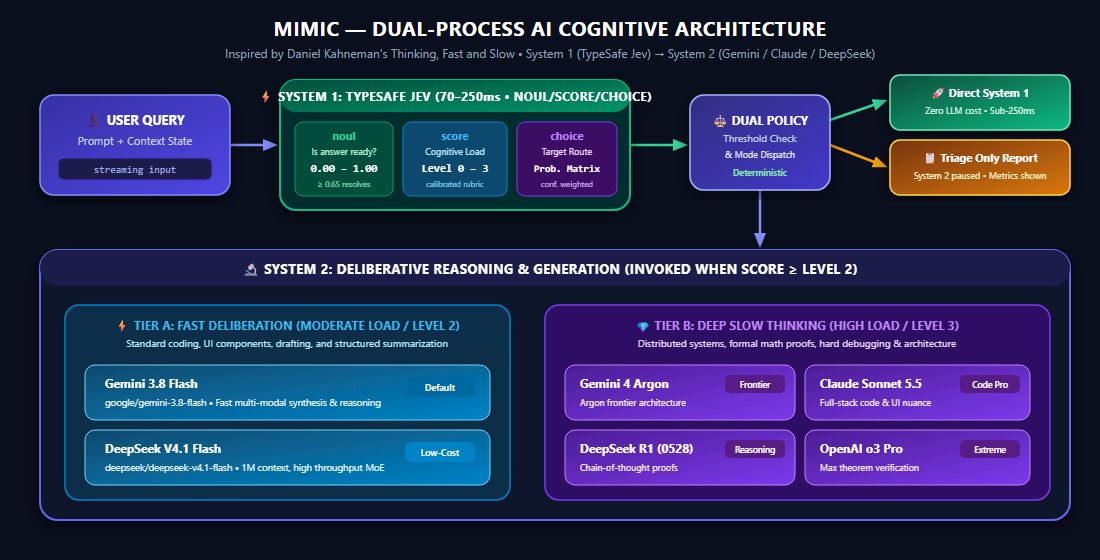
The pipeline operates in two sequential stages.
System 1 (Fast Thinking): Non-Autoregressive Jev Primitives
Instead of generating prose, Jev evaluates the conversation state and returns calibrated typed primitives in parallel:
- noul (Answer Already Present): A calibrated float (0.0 to 1.0) measuring the probability that the question is trivial, already verified, or present in state. If noul ≥ threshold, System 1 answers directly with zero System 2 invocation.
- score (Cognitive Complexity Rubric): An ordered score (0.0 to 3.0) with confidence intervals and probability distributions:
- Level 0: Immediate recall or context reflection.
- Level 1: Concise factual lookup or basic definition.
- Level 2: Moderate synthesis (routes to Fast System 2 Flash tier).
- Level 3: Deep reasoning (routes to Frontier System 2 Argon tier).
- choice (Target Model Selection): Evaluates all active System 2 models against their semantic descriptions and yields an exact probability distribution and winning candidate.
System 2 (Slow Thinking): Frontier Model Tiers
When Jev scores a prompt as requiring deliberative synthesis, it dispatches execution to the winning model:
- Fast Deliberative Tier: Gemini 3.8 Flash (
google/gemini-3.8-flash) and DeepSeek V4.1 Flash (deepseek/deepseek-v4.1-flash) handle routine coding, React components, and summarization with high throughput. - Deep Deliberative Tier: Gemini 4 Argon (
google/gemini-4-argon), Claude Sonnet 5.5 (anthropic/claude-sonnet-5.5), and DeepSeek R1 (deepseek/deepseek-r1-0528) perform deep algorithmic, architectural, and mathematical reasoning.
3. Key Capabilities & Features
- System 1 Triage Only Mode — Evaluates prompts through Jev and pauses before invoking System 2, surfacing full telemetry and model recommendations. Benefit: inspect routing logic, verify choice distributions, and save token costs.
- Immediate Request Cancellation — Native AbortController integration wired into both System 1 and System 2 HTTP requests. Benefit: cancel in-flight queries instantly with zero trailing token spend.
- Local AES-256-GCM Vault — Credentials are encrypted on disk (
.secrets/credentials.enc.json) with a 256-bit key (.secrets/.master.key). Benefit: API keys are never stored in browser localStorage or committed to Git. - OpenRouter OAuth PKCE — 1-click authorization via the RFC 7636 PKCE standard. Benefit: frictionless login without copying secret tokens.
- Dual Provider Fallback — Supports both the OpenRouter Decisions API (
/api/alpha/decisions) and TypeSafe Native Cloud (/v1/systemone). Benefit: high availability across development and enterprise environments.
4. Benchmark Scenarios & Routing Behavior
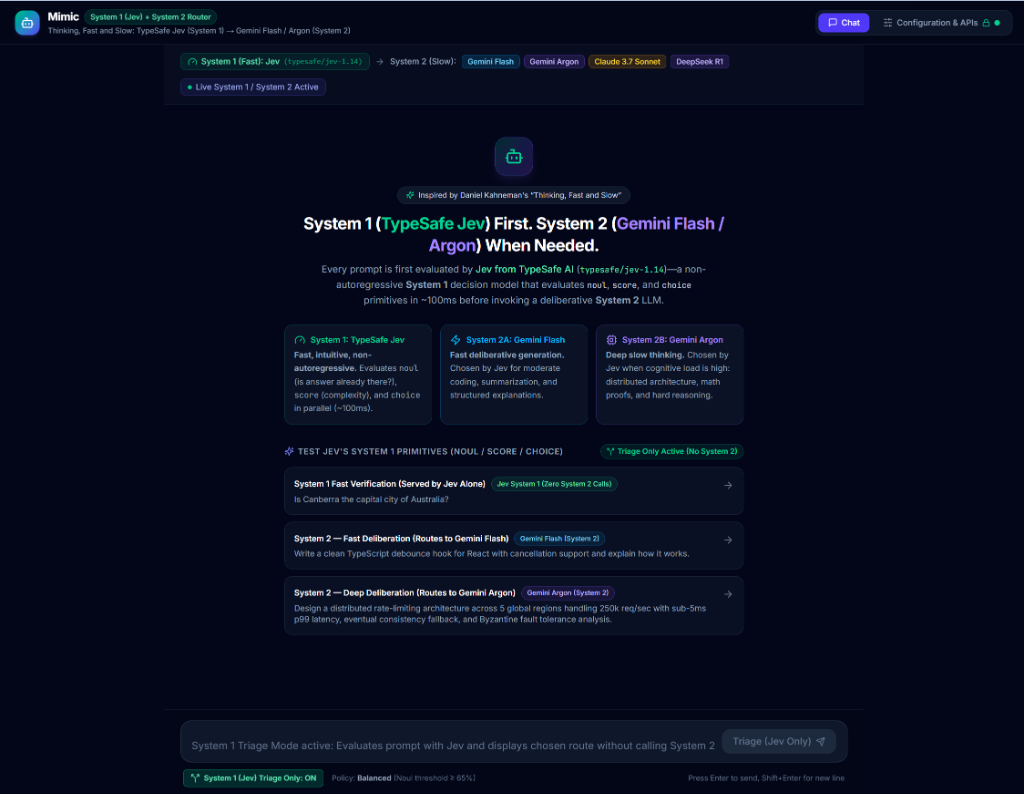
The application includes three benchmark categories demonstrating Kahneman routing in action.
System 1 Pure Verification (Zero System 2 Calls)
- Prompt: "Is Canberra the capital city of Australia?"
- Telemetry: noul = 0.89, score = 0.45 / 3.0, choice = system1_direct (94%)
- Outcome: Resolved in under 200ms entirely by System 1 without waking up an LLM.
System 2 Fast Synthesis (Routes to Gemini Flash)
- Prompt: "Write a clean TypeScript debounce hook for React with cancellation support."
- Telemetry: noul = 0.18, score = 1.92 / 3.0 (Level 2), choice = Gemini Flash (78%)
- Outcome: Fast code generation with minimal latency.
System 2 Deep Deliberation (Routes to Gemini Argon)
- Prompt: "Design a distributed rate-limiting architecture across 5 global regions handling 250k req/sec with sub-5ms p99 latency and Byzantine fault tolerance."
- Telemetry: noul = 0.04, score = 3.00 / 3.0 (Level 3), choice = Gemini Argon (100%)
- Outcome: Comprehensive architectural analysis leveraging deep cognitive capacity.
5. Summary & Getting Started
The future of AI orchestration is not bigger single models, but cognitive division of labor: lightweight, non-autoregressive System 1 intuition paired with powerful, deliberative System 2 reasoning.
To run Mimic locally:
git clone https://github.com/guidooswald/mimic.git
cd mimic
npm install
npm run dev
Visit http://localhost:5173 to explore live dual-process AI routing.